

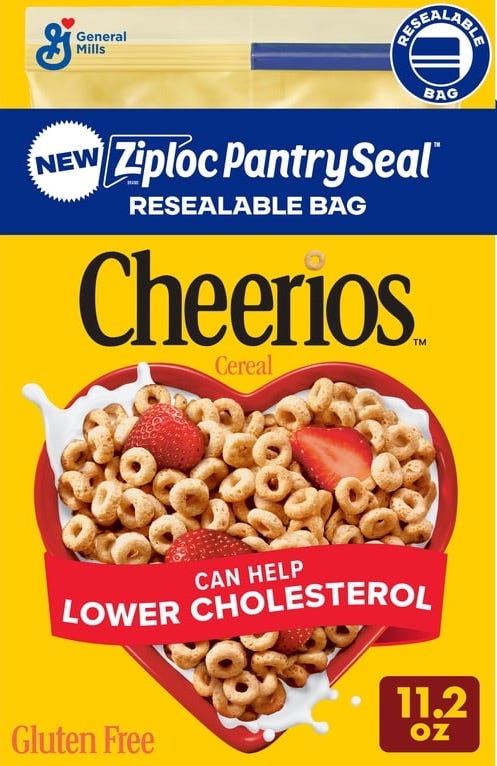
Today, General Mills announced it’s adding Ziploc closures to Cheerios bags. Why this, and why now?
I spent +10 years working on General Mills’ cereal businesses, and resealability is, without question, the most consistently and passionately requested improvement requested by consumers. If you are one of the +90% of US households that has purchased a cereal box in the past year, you know the struggle of opening the bag, the risk of spillage, and the sheer frustration of trying to keep it closed.
So why did it take so long to do this? Because it costs money, and there is no guarantee of a positive ROI. The facts make a pretty compelling business case against the move:
Cost: A resealable feature is expensive, impacting margins and competitiveness.
Growth: The potential is limited. The improvement will make current users happy, but they’re unlikely to eat more cereal because of it, and it’s probably not enough to drive significant brand switching.
Freshness: For many households, cereal is consumed quickly enough that the incremental freshness benefit is limited.
This idea has been evaluated, debated, and killed multiple times because of the financials. I killed it once myself— guilty as charged.
So why do it now? As an outsider, I can only speculate. The financial realities haven’t changed. This is not new technology, and there’s no known competitive pressure forcing this move.
Perhaps the reason is simply that it’s never too late to do the right thing and give consumers what they’ve been asking for.
Implementation won’t come with a free pass. The cost is real and will need to be managed. The team commercializing this innovation will have to work hard to eliminate waste in other areas to pay for this investment. Not an easy task, but a necessary one.
If my speculation is right, then bravo to the Cheerios team for recognizing what is so often missed: just because an improvement doesn’t generate an attractive financial return on a spreadsheet doesn’t mean it has no economic value. Some benefits, like consumer goodwill, brand preference, and loyalty, are simply harder to quantify.
Too often, Big Food confuses what can be measured with what matters.
Even if this move doesn’t sell one additional case of Cheerios, it may accomplish something more valuable over time: giving consumers one more reason to love the brand.
Jessica and I were just discussing this. As a Big G veteran herself, she made all the points you did about why it never happened. But if you are trying to kickstart your growth and you can fix a well known frustration for consumers, perhaps the ROI math isn’t the place to start. I find it encouraging.
Very cool, my daughter and pantry floor will be very appreciative. I wonder if the cost is offset by the partnership with Ziploc? Ziploc get massive marketing impressions outside of their home locations and a huge order to supply the bags (or at least the closures). So the costing for GM gets offset with the partnership, which then allows the idea to get closer to cost neutral. Love the creative thinking on this one from the brands.